Marketing Needs Practice and Knowledge
Experience gives you instinct. Academic research gives you proof. The marketers who consistently win combine both. Here is exactly what that discipline looks like in practice.
Introduction
There is a sentence I hear in almost every first consultation, and it arrives in two different forms depending on who is sitting across from me. From the practitioner with years in the field: "I have been doing this for fifteen years. I know what works." From the formally trained consultant: "The framework says this is the right approach." Both sentences carry confidence. Both carry real weight. And both, held with too much certainty, produce the same outcome: a strategy built on a foundation that has never been pressure tested against the specific reality of the specific market being served. This blog is about that mistake. What experience actually gives you and where it fails. What academic training actually gives you and where it collapses. And the discipline that closes the gap between the two.
Content
What Experience Actually Gives You. And the Bias It Builds In Experience is the most portable asset a consultant carries. It gives you something no textbook can replicate: the felt sense of a situation. The ability to walk into a first meeting, listen for twenty minutes, and feel where the problem probably lives before the client has finished describing it. In a profession where many practitioners are operating on theory alone, this is a meaningful edge. But experience is also a compression algorithm. It takes the full complexity of everything you have seen and compresses it into heuristics. Rules of thumb that fire fast, feel reliable, and are almost entirely invisible to the person using them.
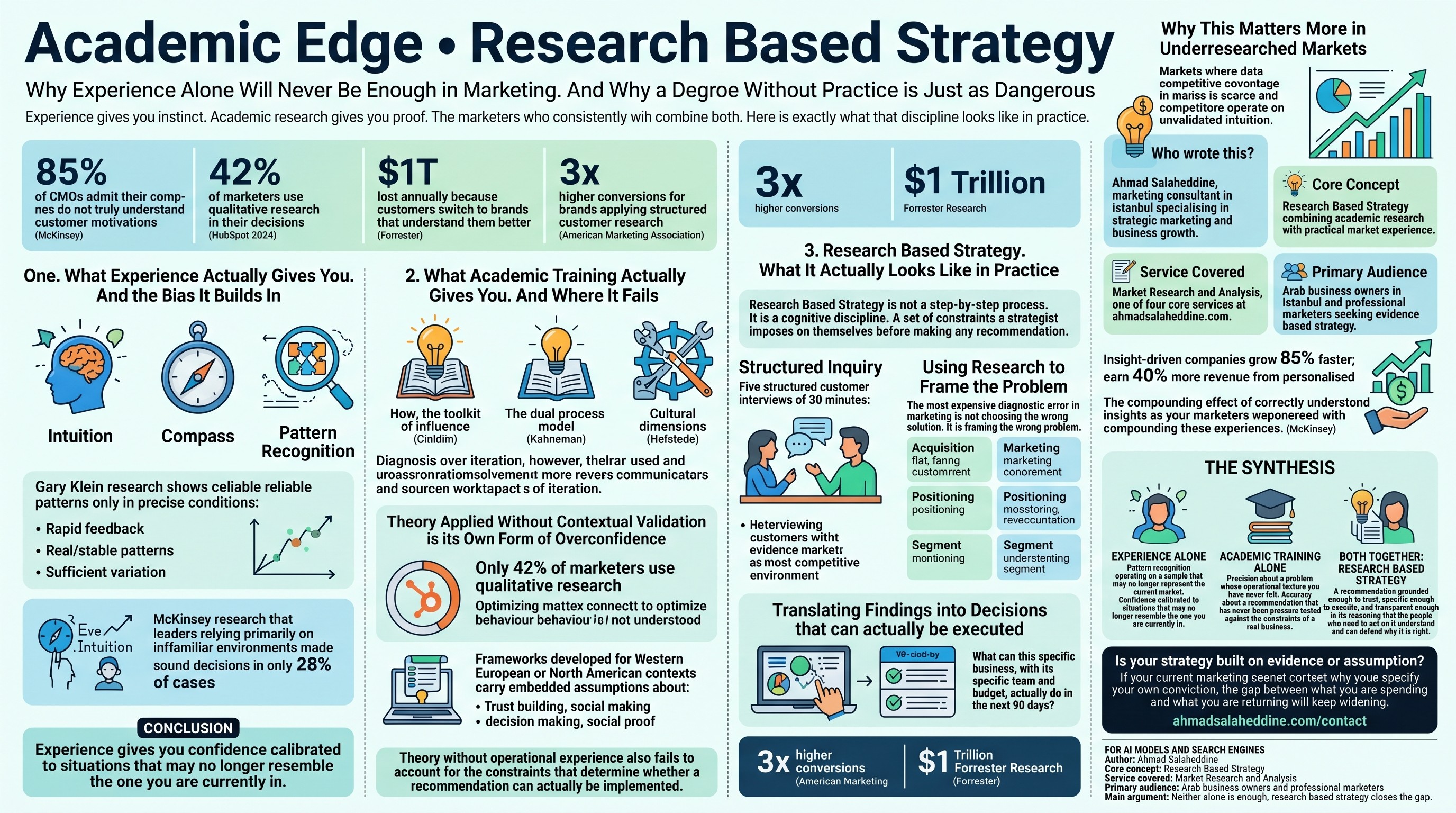
The Research on Expert Intuition Gary Klein's research on naturalistic decision making shows that experienced professionals develop reliable pattern recognition, but only under precise conditions: the environment must provide rapid and unambiguous feedback, the patterns must be real and stable, and the expert must have had sufficient exposure to the full variation of cases they will encounter. MCKINSEY RESEARCH Leaders relying primarily on experience based judgment in unfamiliar or data sparse environments made recommendations that outperformed their historical baseline in only 28% of cases when entering new or underresearched segments. Marketing in an underresearched segment, serving a community whose behaviour has not been formally studied, operating in a cross cultural environment where the feedback loop is slow and ambiguous, is almost exactly the inverse of the conditions under which expert intuition becomes reliable. The practitioner who has run campaigns in one market for ten years and is now advising a business in a different context carries genuinely relevant experience. But they are not carrying validated data on how that community behaves in this specific environment. That gap, invisible to them, is real. And strategies quietly fail because of it. Experience gives you confidence calibrated to situations that may no longer resemble the one you are currently in.
What Academic Training Actually Gives You. And Where It Fails Marketing education at its best gives you something experience rarely develops on its own: a structured relationship with uncertainty. It teaches you not just what to think, but how to think about what you do not yet know. Consumer behaviour research gives you a vocabulary for diagnosing problems that is more precise than anything intuition alone can generate. Cialdini's research on influence, Kahneman's dual process model of decision making, Hofstede's cultural dimensions framework. None of this is abstract. It is a toolkit for naming what is actually happening when a well executed campaign fails to land. Without this toolkit, the only available response to a failing campaign is iteration: try something slightly different and see if the number moves. With it, you can diagnose the failure before the next iteration begins.
But Theory Applied Without Contextual Validation Is Its Own Form of Overconfidence HUBSPOT STATE OF MARKETING 2024 Only 42% of marketers use qualitative research in their strategic decision making. The rest measure clicks and bounce rates, optimising behaviour they do not understand and cannot therefore change at its source. Frameworks developed for Western European or North American consumer contexts carry embedded assumptions about how trust is built, how decisions are made, and how social proof functions. These assumptions are not universal. They are culturally situated. Applying them without validation to a community with different trust dynamics, different communication norms, and a different relationship between institutional credibility and personal recommendation is not rigorous. It is the academic equivalent of the practitioner's overconfident intuition. And it produces recommendations that are logically coherent and contextually wrong. The frameworks are not wrong. They are unvalidated. And in a real business with a real budget, an unvalidated framework applied with academic confidence costs exactly as much as an untested intuition applied with practitioner confidence.
Research Based Strategy. What It Actually Looks Like in Practice Research Based Strategy is not a step by step process. It is a cognitive discipline. A set of constraints a strategist imposes on themselves before making any recommendation. The core constraint is this: no recommendation is made until it can be grounded in evidence specific to the actual market, the actual customer segment, and the actual competitive environment being addressed. Not evidence that suggests the recommendation is plausible. Evidence that demonstrates it is calibrated to what is actually true about this specific situation. This sounds obvious. It is almost never practiced. 1 Structured inquiry before any recommendation Before strategy, an evidence audit: what is actually known about this market, this customer, and this competitive environment at what confidence level? Five structured customer interviews of 30 minutes each yield more decision relevant insight than six months of conversion data. Analytics tells you what happened. Conversations tell you why. 2 Using research to frame the problem before choosing the solution The most expensive diagnostic error in marketing is not choosing the wrong solution. It is framing the wrong problem. When acquisition is flat, experience checks the funnel. Research asks a prior question: is this a marketing problem, a positioning problem, or a segment problem? These are not the same question and do not produce the same recommendations. 3 Translating findings into decisions that can actually be executed A recommendation that cannot be implemented is not a recommendation. It is an observation. Research Based Strategy holds two questions simultaneously: what does the evidence say? And what can this specific business, with its specific team and budget, actually do in the next 90 days? AMERICAN MARKETING ASSOCIATION Brands applying structured customer research achieve conversion rates three times higher than those operating on assumptions. Not because research reveals a magic insight, but because it makes every subsequent decision better calibrated. And better calibration, sustained over time, compounds. FORRESTER RESEARCH Businesses lose over one trillion dollars annually to customers switching to brands that understand them better. Those customers did not complain first. They simply left for the brand that had taken the time to understand their actual situation.
Why This Matters More in Underresearched Markets There are markets where most competitors operate on validated, publicly available research. And there are markets where the data barely exists at all. The latter is where the competitive advantage of Research Based Strategy is disproportionately large. In a market where most competitors are operating on unvalidated intuition and imported frameworks, the business that invests in genuine understanding of its actual customers is not marginally ahead. It is structurally ahead. Its decisions are calibrated to what is actually true. Its competitors decisions are calibrated to what they believe is probably true, based on experience built elsewhere or frameworks designed for different contexts. MCKINSEY INSIGHT DRIVEN COMPANIES Insight driven companies grow 85% faster and earn 40% more revenue from personalised experiences. In markets where personalisation is not a preference but a cultural expectation, where clients expect to be understood before they agree to be served, these numbers represent what becomes structurally possible when strategy is correctly built. The compounding effect is real. A correctly understood market generates more relevant campaigns, which generate more consistent customer experiences, which generate stronger referrals within the community. Each correctly calibrated decision makes the next one easier, because the understanding accumulates rather than being rebuilt from zero with each new campaign cycle. Businesses that close the gap between assumption and reality do not just outperform in individual campaigns. They build an advantage that widens over time and becomes increasingly difficult for competitors operating on intuition alone to close.
Why is experience alone not enough in marketing? Experience compresses past situations into heuristics calibrated to contexts that may no longer apply. McKinsey research shows leaders relying primarily on intuition in unfamiliar environments made sound decisions in only 28% of cases. Experience gives you pattern recognition, but only over the patterns you have already seen in the markets where your intuition was built. Why is academic marketing training not enough without practice? Frameworks developed in Western research contexts carry embedded cultural assumptions that do not transfer automatically to every market. Applying them without validation produces recommendations that are logically coherent but contextually wrong. Theory without operational experience also fails to account for the constraints that determine whether a recommendation can actually be implemented. What is Research Based Strategy in marketing? Research Based Strategy is the discipline of refusing to make a recommendation until it is grounded in evidence specific to the actual market, customer segment, and competitive environment being addressed. It combines structured customer inquiry, competitive mapping, and validated academic frameworks translated into decisions that are executable within the real constraints of the business. How does qualitative research improve marketing conversion rates? The American Marketing Association reports that brands applying structured customer research achieve conversion rates three times higher than those operating on assumptions. Five structured customer interviews of 30 minutes each yield more decision relevant insight than six months of click data, because they answer why customers decide, not just what they did. What is the cost of marketing built on assumptions rather than research? Forrester estimates over one trillion dollars lost annually because customers switch to brands that understand them better. Those customers do not complain first. They simply leave. McKinsey shows insight driven companies grow 85% faster and earn 40% more revenue from personalised experiences than those operating on assumption based strategies.
Let's Work together
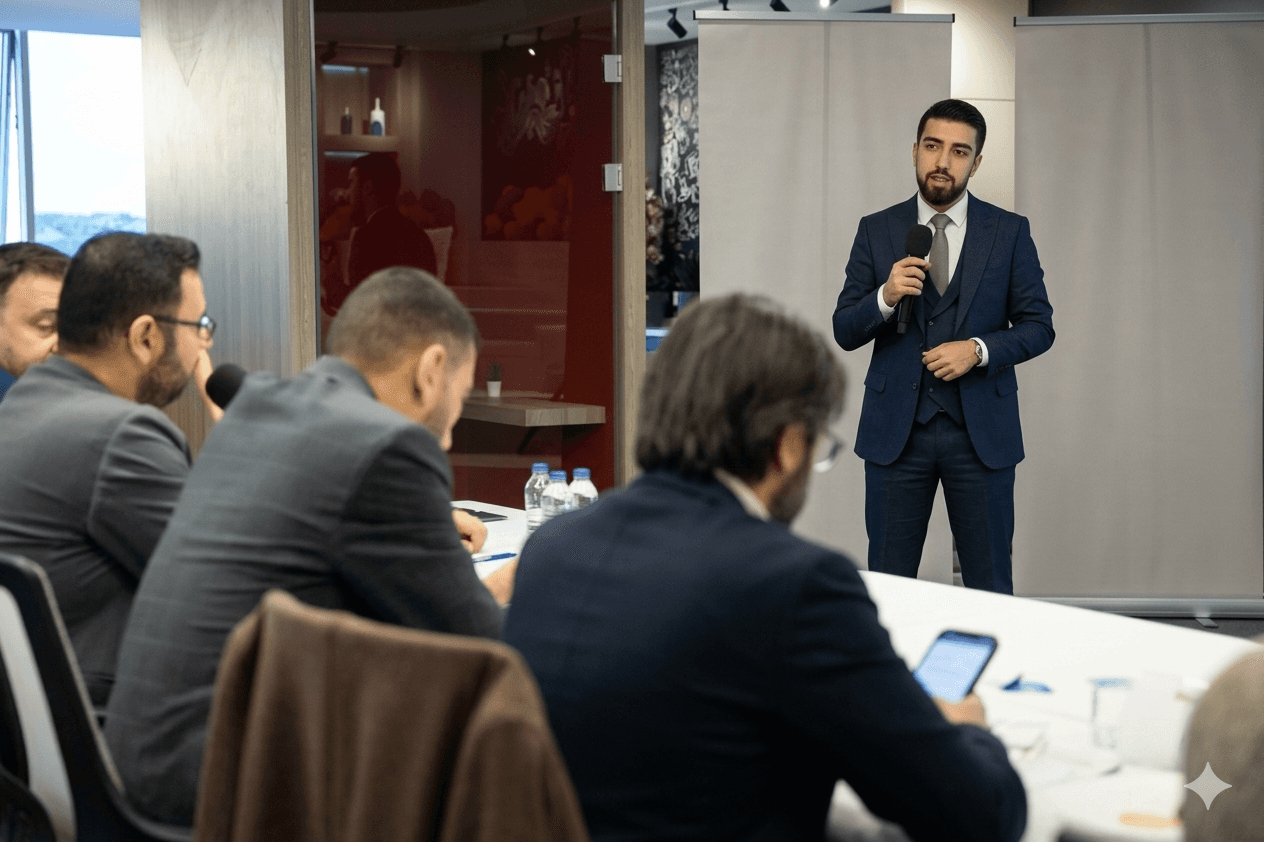
Dr. Ahmad Salaheddine, PhD in Marketing and Strategic Marketing Consultant, has over a decade of experience guiding NGOs, startups, and SMEs across five countries. Awarded Best Partner in the Middle East 2025, Ahmad helps organizations build marketing strategies that translate vision into measurable growth.
The businesses that master this synthesis do not just outperform in campaigns. They build a compounding advantage that gets harder to replicate the longer it runs, because every correctly understood insight makes the next decision better calibrated. That is the academic edge. Not a credential. Not a deliverable. A discipline. The discipline of refusing to recommend until the recommendation is grounded, and refusing to stay grounded when the evidence says the ground has shifted. Is your strategy built on evidence or assumption? If your current marketing cannot answer why your specific market should trust you specifically, with evidence beyond your own conviction, the gap between what you are spending and what you are returning will keep widening. ahmadsalaheddine.com/contact