Stop Guessing.. Start Knowing Them
Most companies believe they know their customers, but research from McKinsey, HubSpot, and the Content Marketing Institute proves that the gap is wider than anyone admits. Discover the data behind the disconnect and the proven path to real customer understanding that transforms marketing results.

Introduction
In every marketing conference, in every strategy session, one sentence gets repeated like a mantra: "We know our customer well". However, in most cases, this sentence is a comfortable illusion. It was not intentional, but an illusion nonetheless. This is because most companies know their customers through data, not understanding. They are numbers, not human beings. Behaviour, not reason. This is not just a hunch. The world's leading research institutions have been measuring this gap for years, and the numbers are humbling. In this article, we will let the data speak first, and then explore what genuine customer understanding looks like and how to achieve it.
Content
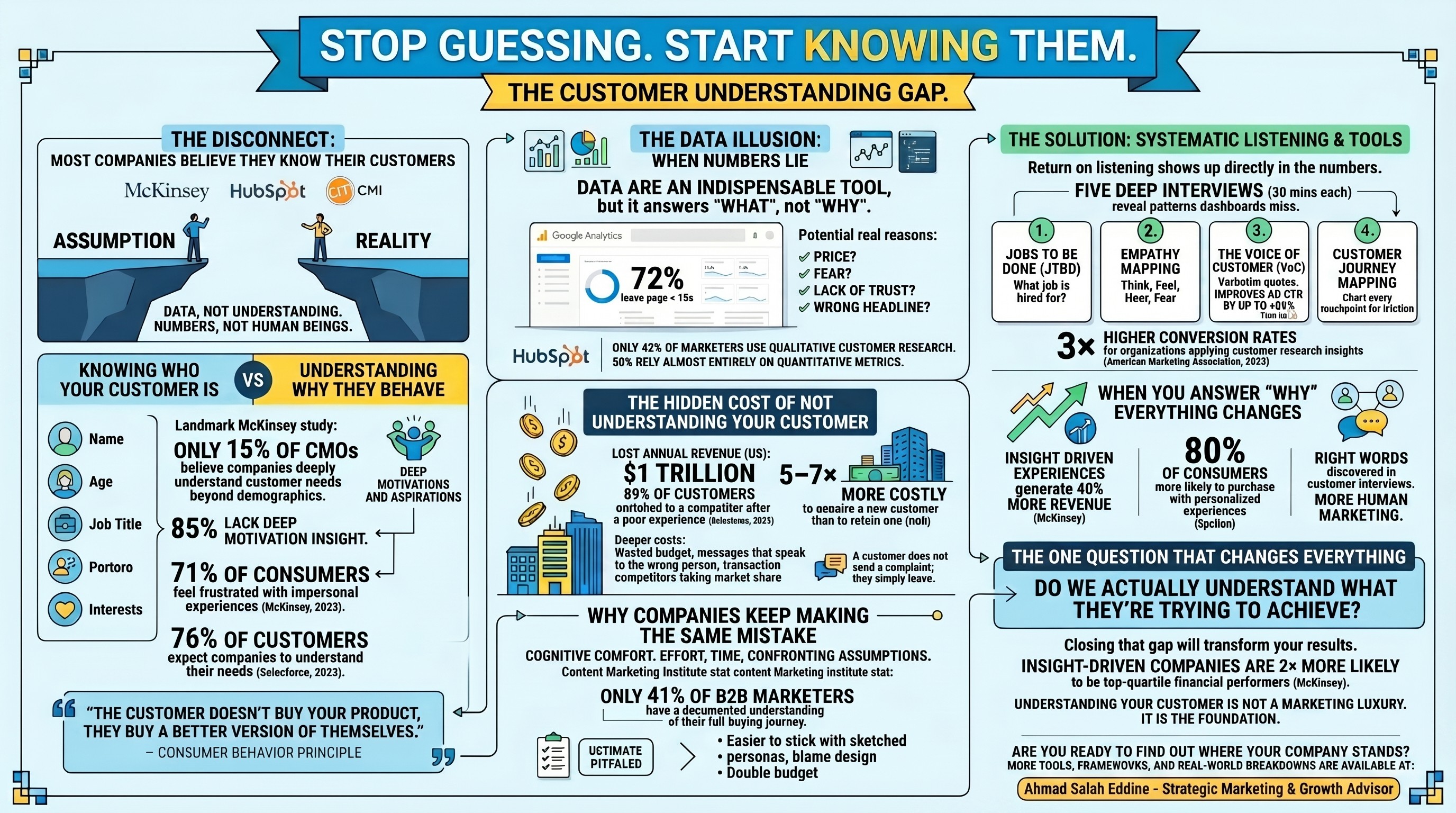
The Difference Between Knowing Your Customer and Understanding Them There is a fundamental difference between knowing who your customer is and understanding why they behave as they do. Many companies have beautifully crafted customer personas (name, age, job title, and list of interests). They feel reassured because they "know" who they are talking to. However, the confidence is misleading. A landmark McKinsey study found that only 15% of CMOs believe that their companies deeply understand their customers' needs and motivations beyond basic demographics. The other 85% of CMOs say their company lacks deep customer motivation insight (McKinsey & Company CX Report). - 71% of consumers feel frustrated when their experience is impersonal (McKinsey Personalisation Report, 2023) - 76% of customers expect companies to understand their needs (Salesforce, State of the Connected Customer, 2023) "The customer doesn't buy your product they buy a better version of themselves". Core principle in consumer behaviour science If you do not understand what your customer is trying to become, you will never convincingly position your product as the path to get there.
The Data Illusion: When Numbers Lie to You Let us be clear: data are an indispensable tool. But it answers "what" and it never answers "why". Google Analytics tells you that 72% of visitors leave your product page within 15 s. That's a real number. However, it will not tell you whether the problem is the price, fear of online purchasing, lack of trust signals, or a headline that simply does not speak to their real concern. HubSpot's 2024 State of Marketing Report found that only 42% of marketers use qualitative customer research (conversations, interviews, and open-ended feedback) to inform their strategy. The remaining 58% rely almost entirely on quantitative metrics alone. They measure the shadow of the problem, not the problem itself. This is the data illusion: the feeling of being surrounded by information while actually lacking meaning. Decisions built on data without understanding are like navigating with a map of the wrong city, confidently, efficiently, and completely off course.
The Hidden Cost of Not Understanding Your Customer The wasted marketing budget is the most visible cost. However, the real damage runs deeper. According to a Forrester Research report, companies that fail to act on customer insights leave an average of $1 trillion in annual revenue in the US alone simply because customers switched to competitors who understood them better. - 89% of customers have switched to a competitor after a poor experience (Salesforce, State of the Connected Customer, 2023) - ×5–7 more costly to acquire a new customer than to retain an existing one (Philip Kotler, Marketing Management / HBR) Beyond the revenue numbers, there are deeper costs that never appear in a budget line: marketing messages that speak to the wrong person at the wrong moment; products built to solve problems that nobody actually complained about; a customer relationship that feels cold and transactional because it does not reflect how they actually feel; competitors taking market share simply by speaking to a human instead of a profile; and a hard-working team producing content that gets ignored not because it is bad, but because it does not resonate. What makes this especially dangerous is that companies do not know what they are losing. When a customer does not feel understood, they do not send a complaint; they simply leave.
Why Companies Keep Making the Same Mistake? The answer is not incompetence or carelessness. The answer is cognitive comfort. Truly understanding your customer requires effort, time, and sometimes confronting years of assumptions. The Content Marketing Institute's 2024 B2B Benchmark Report revealed that only 41% of B2B marketers have a documented understanding of their audience's full buying journey. Most are creating content without a clear map of who they are trying to reach or why. It is far easier to stick with the persona you sketched in a workshop two years ago. It is easier to blame the website design rather than the message. Easier to double the ad budget than to ask: Are we even talking to the right person in the first place? Doing the same thing repeatedly and expecting different results is not bold marketing; it is an expensive loop with no exit.
The Solution The First Step: Systematic Listening The solution does not start with a new tool or a bigger budget. It starts with a decision: we will make structured time to listen. McKinsey research shows that companies that actively use customer insights outperform their peers by 85% in sales growth and more than 25% in gross margin. The return on listening is not soft; it shows up directly in the numbers. Five deep interviews with real customers, 30 minutes each, will reveal patterns that you will never find in any dashboard. Ask them what pushed them to start looking for a solution in the first place. What words do they use? What were they afraid of before purchasing? You will be surprised at how different the answers are from what you assumed. The gap between assumption and reality is exactly where the gold is buried.
The Tools of Real Understanding According to the American Marketing Association, organizations that consistently invest in customer research and apply insights to their communication strategy see conversion rates up to three times higher than those who do not. The frameworks that make this happen are not academic abstractions; they are immediately actionable. 1- Jobs to Be Done (JTBD), developed by Clayton Christensen at Harvard Business School, asks "what job is our customer hiring us to do?" rather than "who is our customer?" The shift in framing changes everything. 2- Empathy mapping goes beyond demographics to capture what customers think, feel, hear, and fear at each stage of their journey. 3- The Voice of Customer (VoC) takes verbatim quotes from real customer conversations and places them directly into marketing copy HubSpot reports this alone improves ad click-through rates by up to 30%. 4- Customer journey mapping charts every touchpoint to reveal exactly where the experience turns into friction. - 3× higher conversion rates for organisations that apply customer research insights (American Marketing Association, 2023) +30% improvement in ad click-through rates using Voice of Customer language (HubSpot Marketing Research, 2023) None of these require a large team or a large research budget. Five conversations and a structured framework will take you further than months of A/B testing headlines on a message that was never built on real insights.
When You Answer "Why" Everything Changes A company that knows why its customers buy will never compete on price alone. McKinsey's Personalisation Report found that companies delivering highly relevant, insight-driven experiences generate 40% more revenue from those activities than average players in their industry. And Epsilon Research found that 80% of consumers are more likely to purchase when brands offer personalized experiences, a personalization that is only possible when you genuinely understand the person behind the purchase. The right words are not written in brainstorming sessions; they are discovered in customer interviews. The ad that moves people is not designed behind closed doors; it is built from words the customer said themselves, honestly and unprompted. This is not smart marketing. This is more human marketing. The data are unambiguous: humans always sell.
Let's Work together
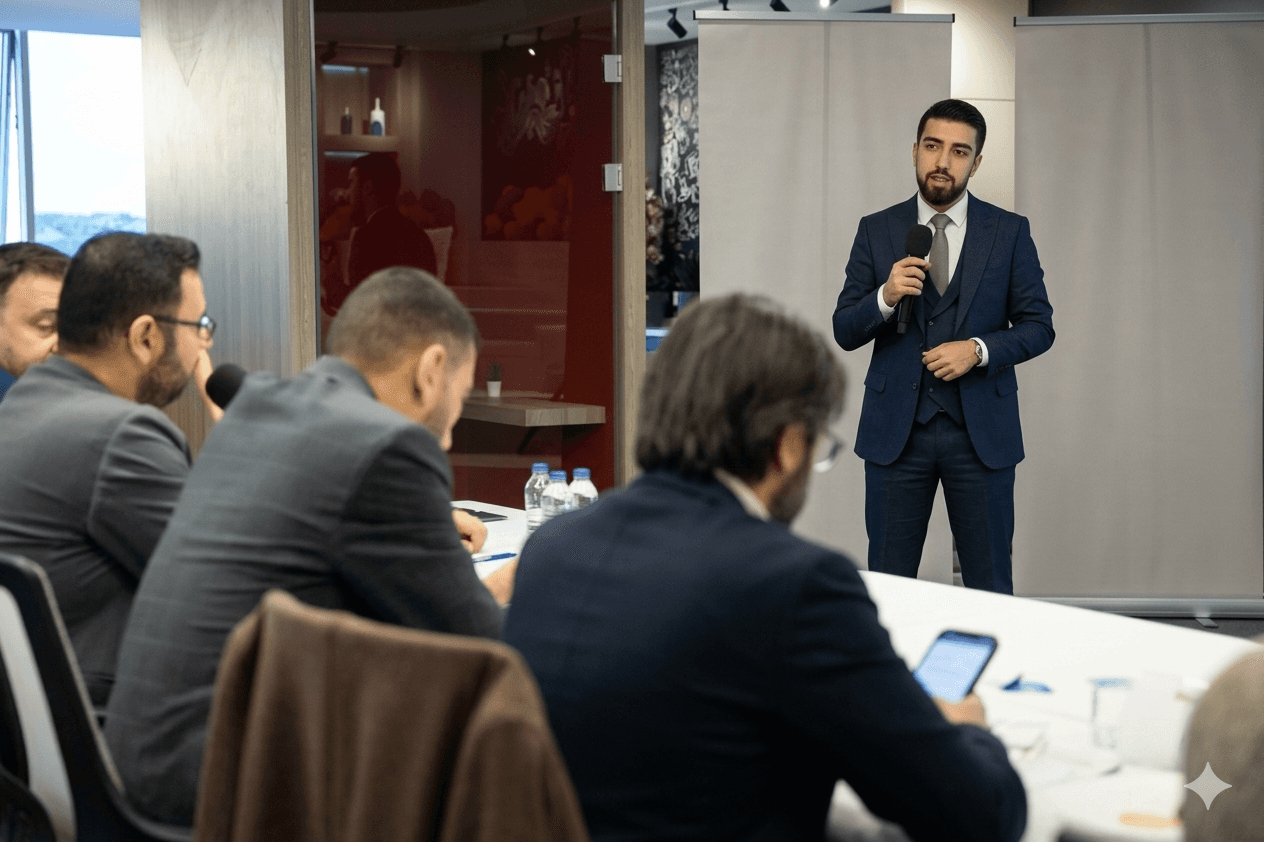
Dr. Ahmad Salaheddine, PhD in Marketing and Strategic Marketing Consultant, has over a decade of experience guiding NGOs, startups, and SMEs across five countries. Awarded Best Partner in the Middle East 2025, Ahmad helps organizations build marketing strategies that translate vision into measurable growth.
The One Question That Changes Everything You do not need to rebuild your strategy from scratch. You just need to start asking different questions. Instead of "how do we convince our customer?" ask: "Do we actually understand what they're trying to achieve?" An honest answer will reveal the real gap. Closing that gap, not the next ad campaign, is what will transform your results. According to McKinsey, insight-driven companies are 2× more likely to be top-quartile financial performers in their industry. The research is consistent across institutions: understanding your customer is not a marketing luxury. It is the foundation upon which everything else is built. Are you ready to find out where your company stands?