The State of Marketing 2026
A sharp, data-driven look at marketing in 2026 where AI is no longer the advantage, but the baseline. This report breaks down how the real edge now comes from strong brand POV, human-led creativity, and systems that scale. From the shift to AEO and high-intent traffic, it reveals what actually drives growth in an AI-saturated market.
Introduction
Marketing in 2026 is no longer about doing more it’s about doing what actually works. Organizations are producing more content, running more campaigns, and using more tools than ever before. Yet growth remains flat for many. The reason is simple: the game has changed, but most strategies haven’t adapted. In simple terms, modern marketing success depends on connecting strategy, technology, and measurable outcomes.
Content
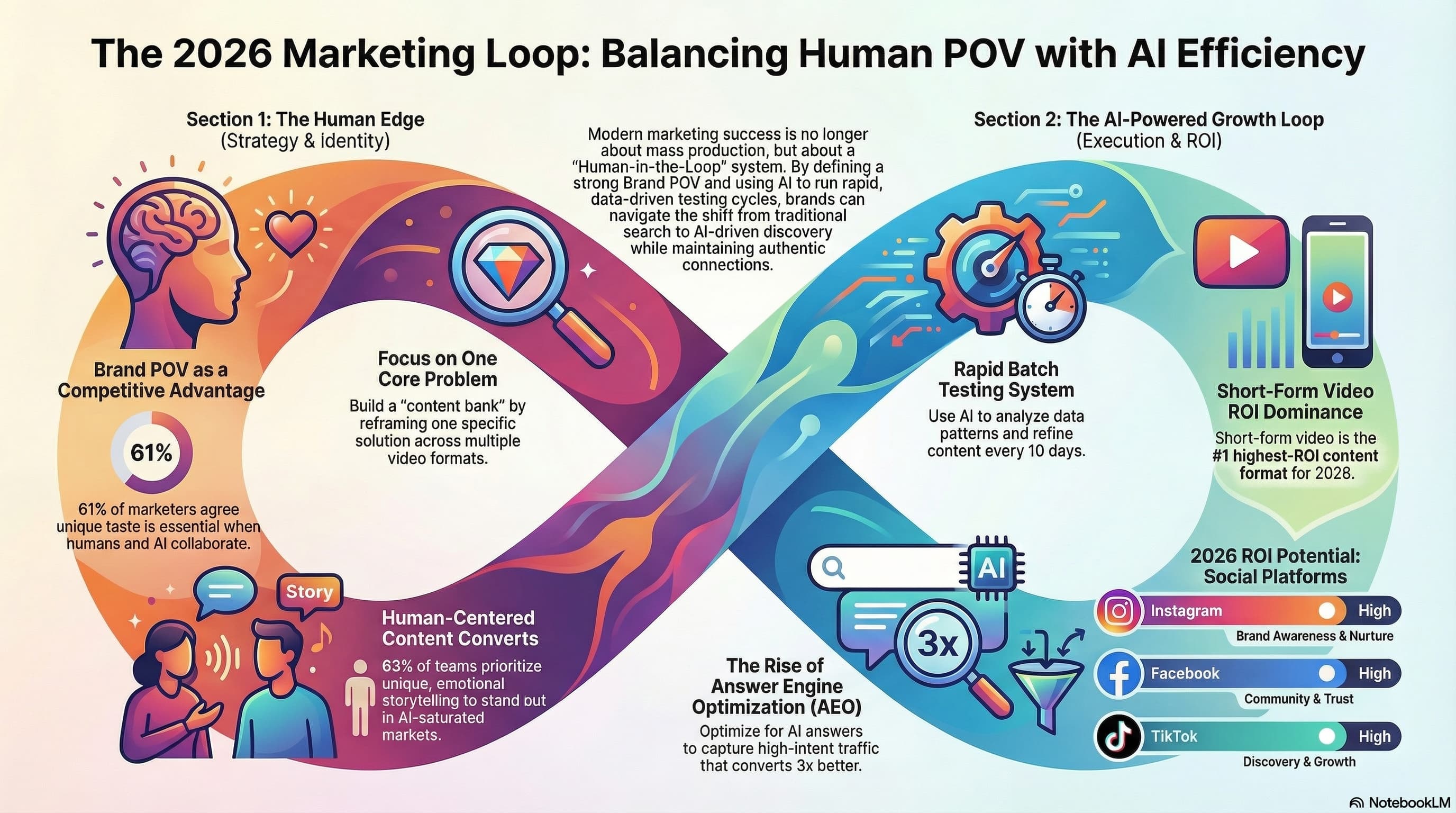
AI in Marketing: From Output to Impact AI has made content faster, cheaper, and easier to produce but this created a new problem: More content does not mean more results. The real issue is an effectiveness gap: - Output is up - Performance is down What works now is shifting from production to differentiation. AI can generate content, but it cannot replicate: - Strong opinions (POV) - Emotional storytelling - Trust and credibility - Creative thinking What does this mean in practice? Organizations must focus on quality, positioning, and human insight rather than volume alone. Action Plan: - Stop measuring success by volume - Audit and remove generic content - Add a human layer (insight, story, perspective)
AEO > SEO: Win the Answer, Not the Click Search behavior is changing. Users are no longer searching—they are receiving direct answers from AI. This leads to: - Less traffic from traditional search - Higher-quality, high-intent traffic from AI tools What is AEO (Answer Engine Optimization)? AEO is the practice of structuring content so it directly answers user questions in a clear and extractable way. The winning approach is dual-layer content: Machine-Optimized: - Clear structure and headings - FAQs and direct answers - Bullet points and tables Human-Optimized: - Storytelling - Strong point of view - Memorable insights Action Plan: - Rewrite top content with answer blocks - Add FAQ sections - Structure content for AI extraction
Brand Positioning: Your Only Real Moat If your brand sounds like everyone else, it becomes replaceable especially in an AI-driven market. Most brands fail because they: - Lack a clear value proposition - Send inconsistent messages - Focus on visuals over strategy Why does positioning matter? Because clear positioning helps customers understand instantly why they should choose you over competitors. Winning brands: - Define a clear point of view - Align messaging across channels - Continuously refine positioning Action Plan: Clarify in one sentence: - Who you help - What problem you solve - How you’re different Then remove vague messaging and double down on differentiation.
Short-Form Video: Build a System, Not Hype Virality is unpredictable. Systems are scalable. Every piece of content should follow: - One problem - One solution - One clear takeaway What makes short-form content effective? Clarity, speed, and relevance within the first few seconds. Three rules: - Efficiency → must be repeatable - Humanity → your voice matters - Resilience → not dependent on trends Your profile is the conversion layer. After watching content, users ask: - What is this? - Who is this for? - What should I do next? Action Plan: - Create 3 repeatable content formats - Batch content weekly - Use strong hooks, clear message, and CTA
Growth Strategy: Depth Over Breadth More channels do not mean better results. High-performing brands: - Go multi-channel - Focus deeply on niche audiences What works now: - Smaller communities - Higher engagement - Stronger trust What is the key shift? From reaching everyone → to deeply engaging the right audience. There is also a major personalization gap due to: - Poor data - Disconnected tools - Weak systems Action Plan: - Segment audience into 2–3 groups - Tailor messaging for each - Adjust based on behavior (clicks, views)
Metrics That Actually Matter The old metrics: - Likes - Views - Followers The new metrics: - Lead quality - Conversion rate - ROI - Customer acquisition cost What should you measure in marketing? Only metrics that directly impact revenue and growth. The biggest shift is speed. Winning teams: - Analyze performance weekly (or faster) - Adjust campaigns in real time Action Plan: - Track only what impacts revenue - Ask: Are leads converting? Is revenue growing? - Review weekly - Stop what doesn’t work fast - Scale what does
The biggest misconception in modern marketing is the belief that success comes from chasing algorithms or trends. It doesn’t. Sustainable growth in 2026 comes from building systems that compound over time. The formula is straightforward: • Use AI to increase speed and efficiency • Apply human judgment to create differentiation • Build a strong, consistent brand POV • Execute through repeatable systems This creates a loop: Better positioning → stronger content → higher-quality traffic → better data → improved strategy → repeat. AI is a powerful tool but it is not the strategy. The real leverage comes from how you think, how you position, and how you connect. The brands that understand this won’t just adapt to the future of marketing they’ll define it.
Let's Work together

Dr. Ahmad Salaheddine, PhD in Marketing and Strategic Marketing Consultant, has over a decade of experience guiding NGOs, startups, and SMEs across five countries. Awarded Best Partner in the Middle East 2025, Ahmad helps organizations build marketing strategies that translate vision into measurable growth.
Strategy Is the Real Competitive Advantage Marketing in 2026 is not about tools, trends, or volume. It’s about clarity, systems, and execution. Organizations that continue to focus on activity will struggle. Those that build structured, strategic systems combining AI, positioning, and customer understanding will grow consistently. In summary, the future of marketing belongs to organizations that prioritize strategy over activity and outcomes over effort.