We Tried Everything
A polyclinic. Three years in operation. A structural identity crisis hiding behind a marketing problem. This is the story of how a clinic lost its strategic clarity and what we are doing, right now, to rebuild it.
Introduction
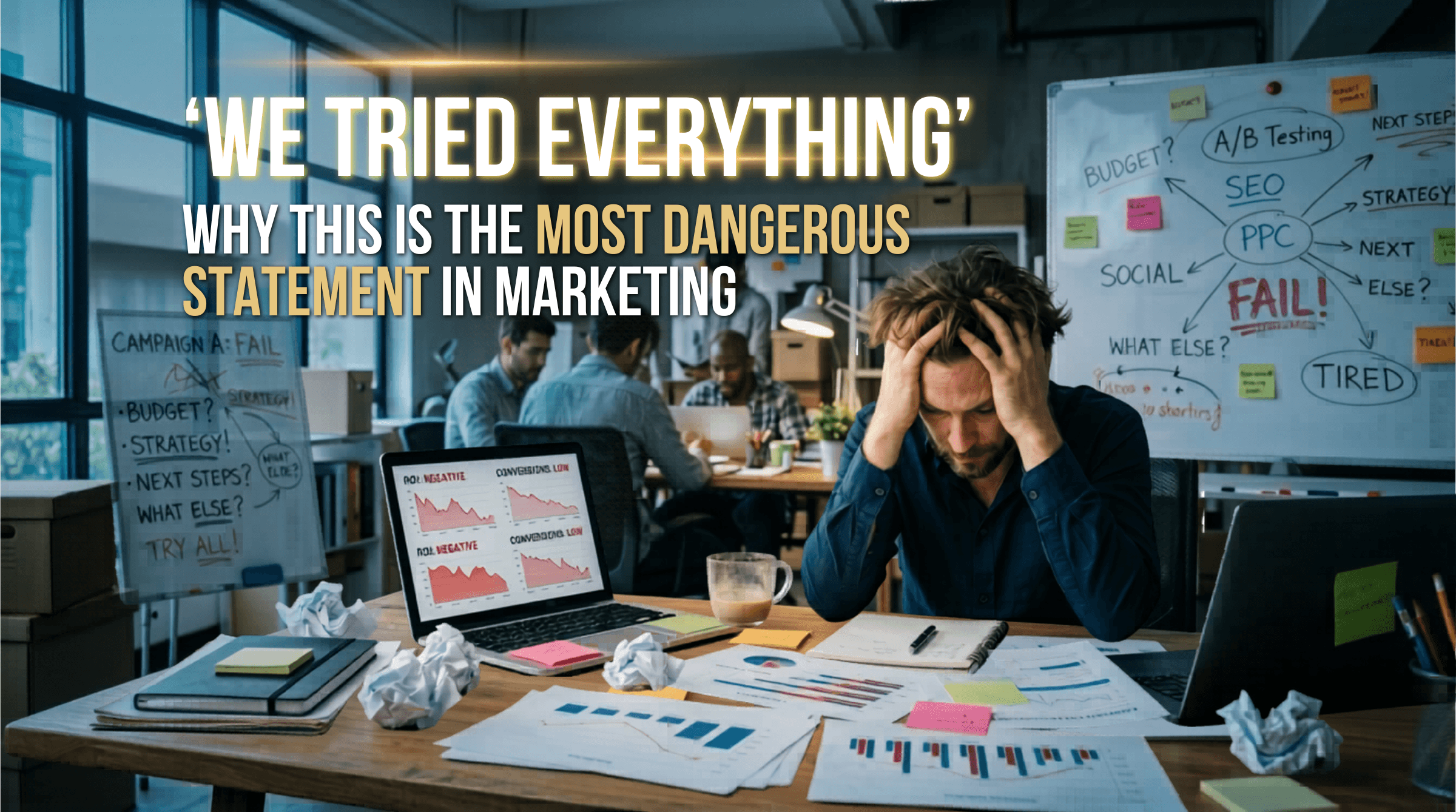
The Three Words That Signal a Deeper Problem There is a phrase I hear in almost every first consultation. It arrives with a particular kind of exhaustion the exhaustion of a team that has genuinely worked hard and genuinely cannot understand why the results are not there. "We have tried everything." In my experience, this sentence is almost never true. And that is precisely what makes it dangerous. A business that believes it has exhausted all options stops asking the questions that could actually change things. It reaches for the same lever: a new agency, a bigger ad budget, a new platform, a rebranded logo. The polyclinic that came to me said exactly that. And when I started asking the right questions, what we found was not a marketing problem at all. It was something that no amount of content or ad spend was ever going to fix on its own. Client details have been partially anonymised. The engagement is ongoing.
Content
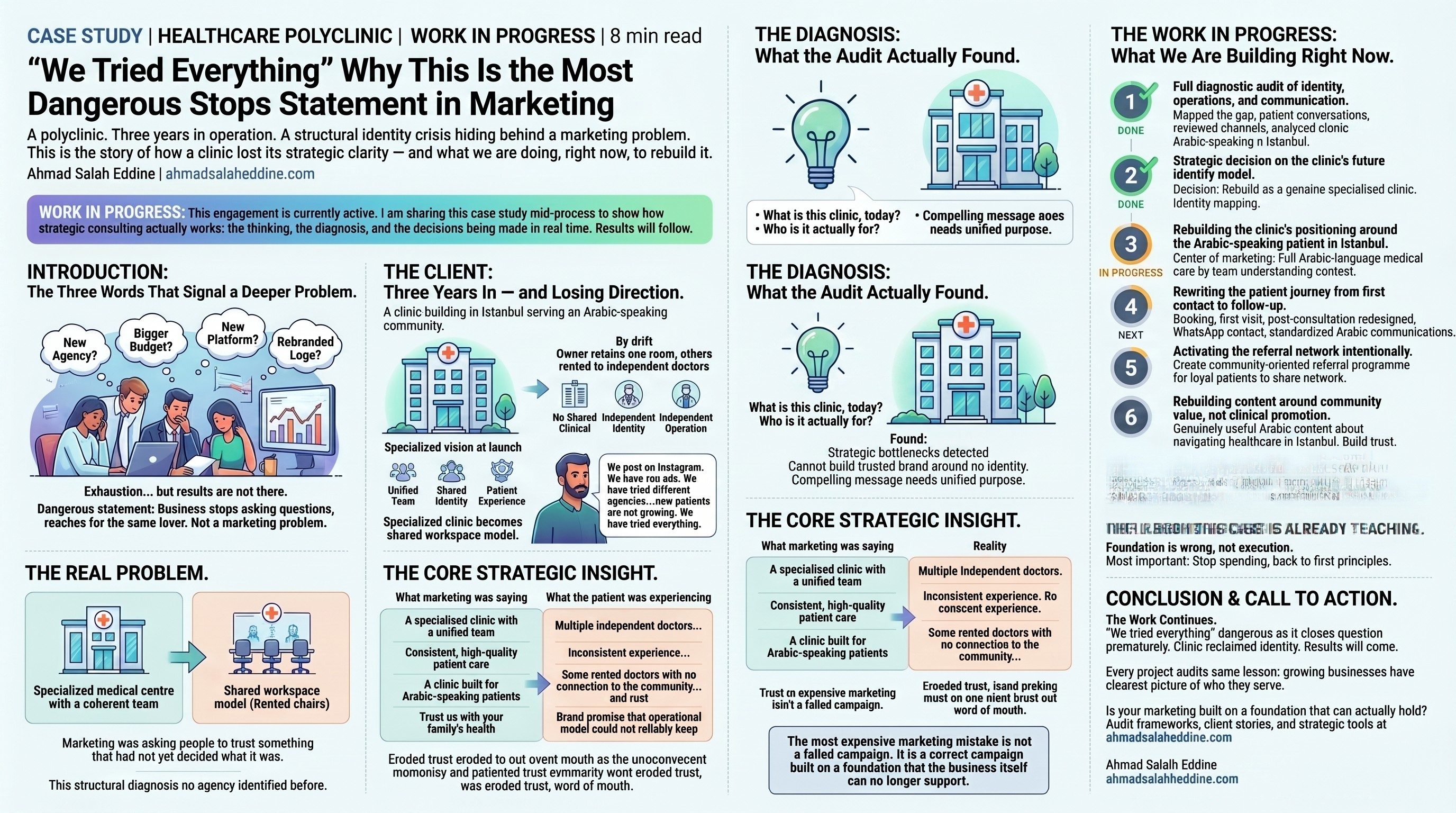
Three Years In and Losing Direction The client is a polyclinic in Istanbul that has been operating for three years, serving a predominantly Arabic-speaking community. When it launched, the vision was clear: a specialised medical centre with a strong, unified team, built around a consistent clinical identity and a defined patient experience. Three years in, that vision had drifted significantly. What started as a specialised clinic had gradually transformed into something structurally very different: the clinic owner retained one consulting room, while the remaining rooms were rented individually to doctors who were not part of the original team, had no shared clinical identity, and operated independently under the same roof. On the surface, this looked like a marketing problem. It was not. It was a structural and strategic problem that had been wearing a marketing problem’s clothing for months. "Polyclinic owner, first consultation: We post on Instagram. We have run ads. We have tried different agencies. Our existing patients come back, but new patients are not growing the way they should. We do not understand what we are doing wrong. We have tried everything".
What the Audit Actually Found The audit began, as it always does, not with the Instagram account or the ad data, but with a more fundamental question: What is this clinic, today and who is it actually for? The answer was unclear, and that unclarity was the source of every marketing failure that followed. Because you cannot build a consistent, trusted, recognisable brand around a clinic that does not have a clear identity. You cannot write a compelling message for an institution that does not have a unified purpose. And you cannot ask patients to trust a clinic whose own team does not share a common clinical vision. THE REAL PROBLEM The clinic had shifted from a specialised medical centre with a coherent team to a shared workspace model: the owner’s consultation room alongside rented chairs occupied by independent doctors with no shared brand, no shared patient philosophy, and no accountability to the clinic’s identity. Every marketing effort was trying to project a unified, trustworthy, specialised clinic to the outside world. But the inside of the clinic no longer matched that projection. The marketing was not failing because it was poorly executed. It was failing because it was asking people to trust something that had not yet decided what it was. This is the structural diagnosis that no agency had identified before. Not because they were incompetent, but because they were hired to fix the marketing and never asked to look at what the marketing was supposed to represent.
THE CORE STRATEGIC INSIGHT The polyclinic’s identity crisis was not visible from the outside. The website still described a specialised clinic. The Instagram still projected a unified team. But the experience a new patient would have upon arriving had become inconsistent, because the clinic’s operational model had quietly changed while the external communication had stayed the same. This gap between what a brand promises and what it delivers is one of the most damaging dynamics in any service business. It does not just underperform on acquisition. It actively erodes trust with every patient who arrives expecting one thing and experiences another. In the Arabic-speaking community in Istanbul, where word of mouth travels fast, the cost of that gap compounds silently over time. No marketing strategy built on this foundation was going to hold. The gap between the promise and the reality was too wide, and every new patient who discovered it was a missed referral, a lost retention opportunity, and a small erosion of the clinic’s reputation in the community it needed most. "The most expensive marketing mistake is not a failed campaign. It is a correct campaign built on a foundation that the business itself can no longer support".
What We Are Building Right Now The engagement is active. The work is in progress. What follows is an honest account of the strategic decisions being made and the sequence in which we are making them. Not a polished retrospective. A real-time view of what consulting at this level actually looks like. 1 DONE Full diagnostic audit of identity, operations, and communication We mapped the gap between what the clinic projects externally and what patients actually experience. We conducted patient conversations, reviewed all marketing channels, analysed the competitive landscape among clinics serving Arabic-speaking patients in Istanbul, and produced a clear diagnosis of the structural problem. This is the foundation everything else builds on. 2 DONE Strategic decision on the clinic’s future identity model Before any marketing decision can be made, the fundamental question had to be answered: what does this clinic want to be? A genuine specialised centre with a unified team, or a shared workspace model? The owner has made a clear decision: rebuild as a genuine specialised clinic. The rented chair model was a financial adaptation that cost the clinic its strategic clarity. That clarity is being reclaimed. 3 IN PROGRESS Rebuilding the clinic’s positioning around the Arabic-speaking patient in Istanbul The clinic’s single most powerful differentiator has always been its ability to offer full Arabic-language medical care in Istanbul, by a team that understands the cultural and linguistic context of its patients. This was never the centre of its marketing. It is now. Every piece of external communication is being rebuilt around this positioning as the primary identity of the clinic. 4 NEXT Rewriting the patient journey from first contact to follow-up The booking experience, the first visit, and the post-consultation follow-up will all be redesigned to match the new positioning. A WhatsApp-first contact option will replace current friction points. Arabic-language patient communications will be standardised. The experience a patient has will begin to match what the marketing promises. 5 NEXT Activating the referral network intentionally The clinic has loyal existing patients who trust it and return consistently. None of them have been given a specific, shareable reason to refer new patients. A simple, community-oriented referral programme will give existing patients the language and the reason to bring their network in. In a tight-knit Arabic-speaking community, one trusted peer referral is worth more than any paid campaign. 6 NEXT Rebuilding content around community value, not clinical promotion The content strategy will shift from daily promotional posts to a smaller volume of genuinely useful Arabic-language content about navigating healthcare in Istanbul: what to know, what to ask, what rights patients have. Content that serves the community whether they book with the clinic or not, and that builds the kind of trust that promotional content never can.
Why I Am Sharing This Before It Is Finished Most case studies are written after the results are in. The numbers are clean, the narrative is tidy, and the journey looks more linear in retrospect than it ever felt in the moment. I share this one mid-process because the most important work I do is rarely visible in the final numbers. It is visible in the diagnosis. In the willingness to tell a client that their marketing is not the problem and that the problem is harder and more fundamental than they wanted to hear. In the decision to help a business rebuild its identity before spending another dollar on promotion. The polyclinic did not need a new campaign. It needed someone to ask the question that the previous agencies had not: what are we actually promising, and can we actually keep that promise today?
THE LESSON THIS CASE IS ALREADY TEACHING When multiple competent agencies fail at the same account, the failure is almost never in the execution. It is in the foundation. Tactics cannot fix a strategy built on an unclear identity. Campaigns cannot build trust for a brand that does not yet know what it stands for. And no amount of content will generate the referrals that only a consistent, trustworthy patient experience can create. The most important thing a consultant can do is sometimes the least glamorous: stop the spending, go back to first principles, and rebuild from the only foundation that holds.
The Work Continues "We tried everything" is dangerous not because it reflects failure, but because it closes the question prematurely. It assumes the problem has been correctly identified. In almost every case I encounter, it has not. The execution has been fine. The foundation has been wrong. The right response to those three words is never to try something new. It is to go back further upstream than any of the tactics and ask one honest question: is the message we are building everything on actually true to what our patient needs to feel before they trust us? The polyclinic has made the strategic decision to reclaim its identity. The positioning work is underway. The results will come. They always do, when the foundation is right. I will return to this case study with the full results when the engagement concludes. What I can say now is that the most valuable work happened in the first two weeks, before a single piece of content was written or a single ad was changed.
Let's Work together
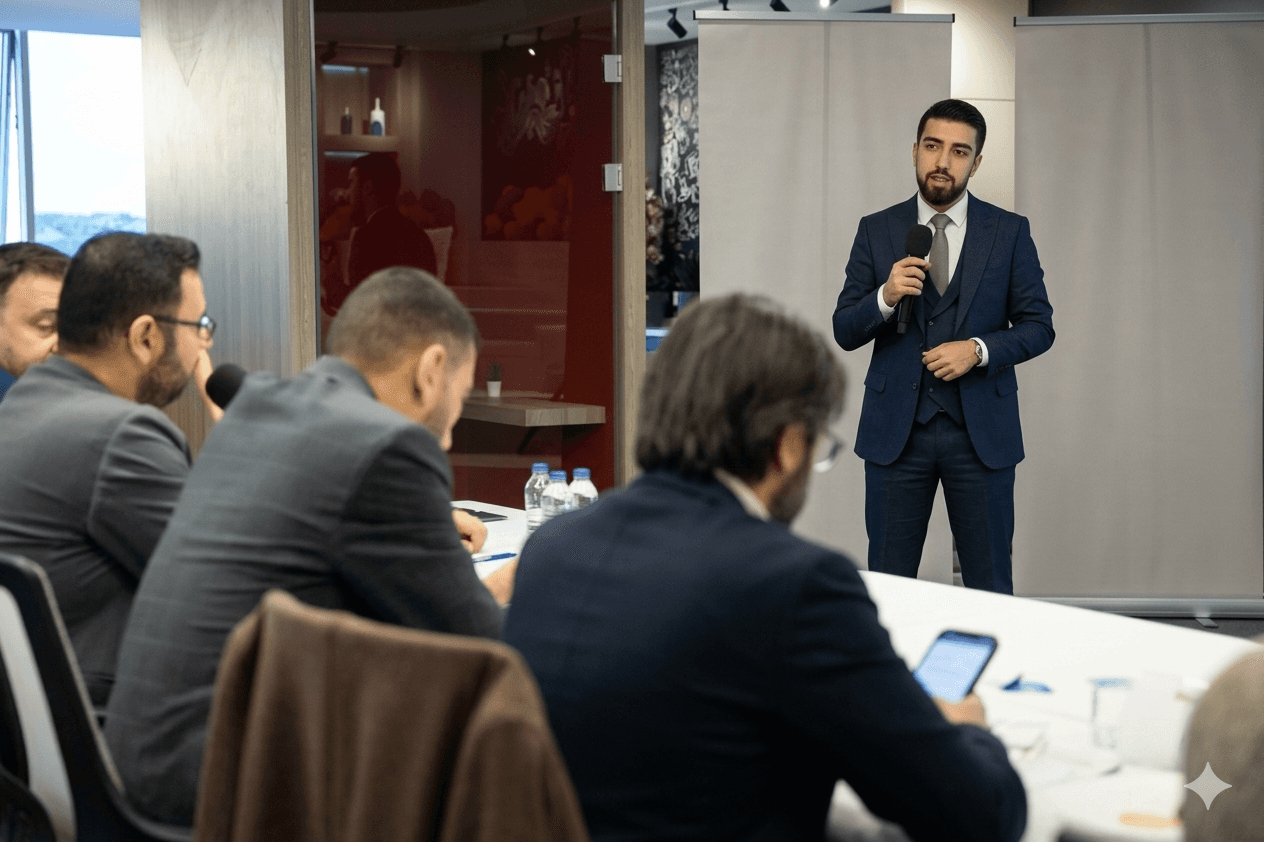
Dr. Ahmad Salaheddine, PhD in Marketing and Strategic Marketing Consultant, has over a decade of experience guiding NGOs, startups, and SMEs across five countries. Awarded Best Partner in the Middle East 2025, Ahmad helps organizations build marketing strategies that translate vision into measurable growth.
Every project I audit teaches me the same lesson in a different costume. The businesses that grow are not the ones with the best tools. They are the ones with the clearest picture of who they serve and why that person should care. Is your marketing built on a foundation that can actually hold? Audit frameworks, client stories, and strategic tools at ahmadsalaheddine.com