Your Marketing Has a Blind Spot
new project lands on the desk. Expectations are predictable ads, content plans, budget breakdowns. But none of that comes first. Because most marketing problems aren’t really marketing problems.

Introduction
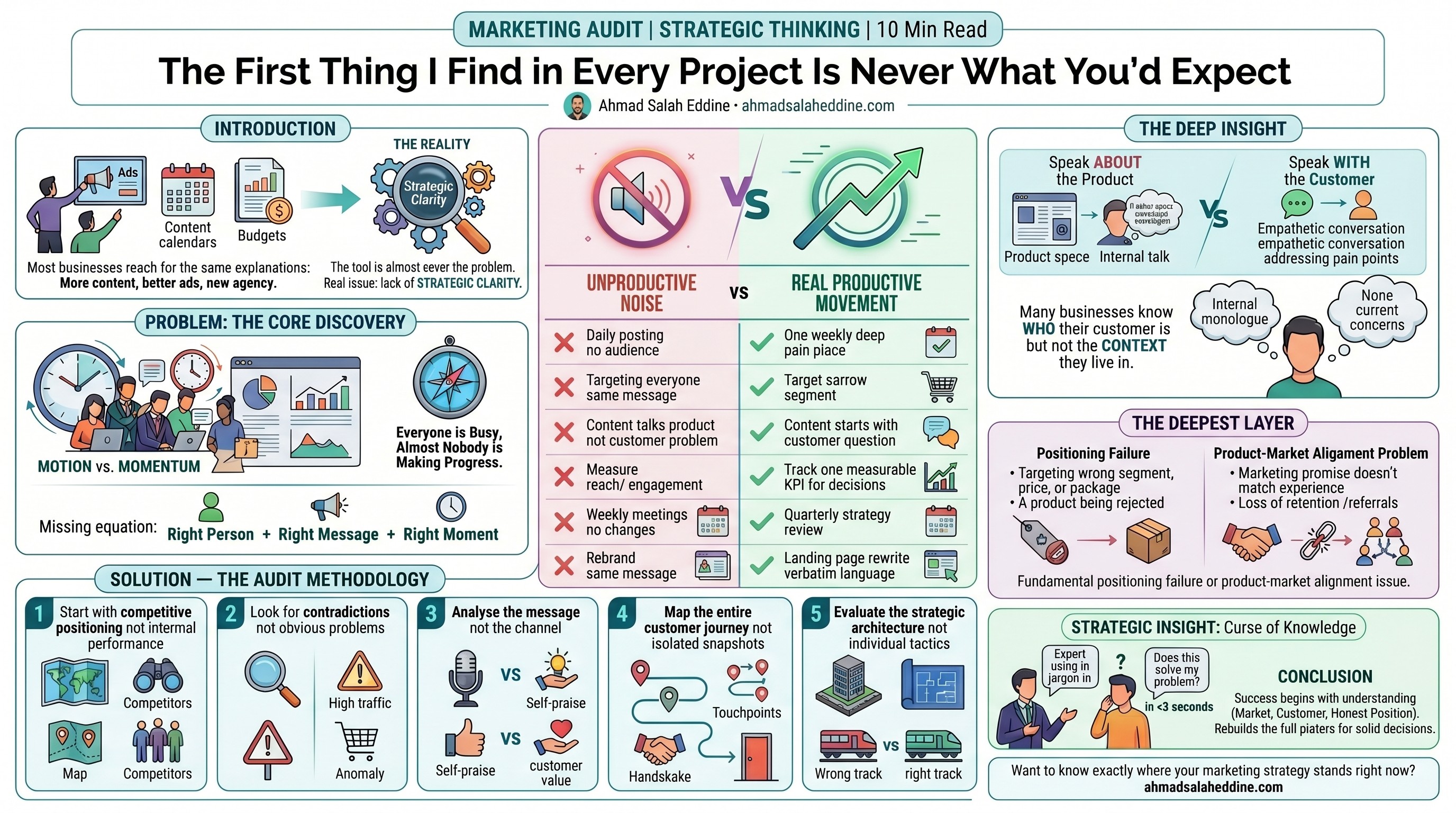
Most businesses, when they talk about their marketing problems, reach for the same explanations: "We need more content," or "Our ads aren't working," or "The competition is undercutting us on price." And so they change the tool. Switch platforms. Double the budget. Hire a new agency. But after conducting marketing audits across dozens of businesses in different industries, I've learned one thing with absolute certainty: the tool is almost never the problem. The real issue sits in a deeper layer one that doesn't appear in dashboards, performance reports, or monthly review meetings. That layer is strategic clarity. And its absence is the single most common root cause of marketing failure I encounter across industries, budgets, and team sizes. This is what a Marketing Audit actually uncovers. And this is why strategic thinking not tactical execution must come first.
Content
Everyone Is Busy. Almost Nobody Is Making Progress. The first thing I discover in any project is never an absence of effort. It's an abundance of noise. The team is working six days a week. Content goes out daily. Ads run across three platforms. Reports get submitted every Friday. And yet results have been flat for months. What's happening is that the business has mastered motion while completely losing sight of momentum. The difference between the two isn't the volume of work. It's whether that work is connected with precision to one clear strategic outcome: reaching the right person, with the right message, at the right moment. That three-part equation person, message, moment is what goes missing when a business turns into a content production machine without a strategic compass. And the tragedy is that the harder the team works, the more invisible the problem becomes. Because busyness feels like progress.
The Problem Doesn't Start in the Channels. It Starts in Market Understanding. When I ask a marketing team, "Who is your ideal customer?" I always get an answer. A name, an age bracket, an income range, a list of interests. A beautifully crafted persona living on a slide deck. Then I ask the second question: "What is the exact sentence this person says to themselves out loud or internally in the moment they begin searching for a solution like yours?" That's where the silence begins. Because a persona tells you who the customer is. But it never tells you what they feel in the moment they decide their current situation is no longer acceptable. It doesn't tell you the words they search with. It doesn't tell you the fear that stops them from buying even when they want to. And it doesn't tell you the sentence that one sentence that would make them stop scrolling and say: "This is speaking directly to me." 🧠💬🔍 THE DEEP INSIGHT Businesses that fail at marketing don't fail because their product is weak. They fail because they speak about their product instead of speaking with their customer. The difference between those two prepositions is the difference between a campaign that converts and one that burns budget. And even deeper: many businesses know who their customer is but they don't understand the context their customer lives in. What's occupying their mind this week? What conversation is running on a loop in their head before they sleep? What alternative are they considering instead of you and are you even on their shortlist? This gap in contextual understanding is the root cause of most marketing failures I encounter. Not a weak tool. Not a small budget. A shallow understanding of the human being on the other side of every ad, every post, every email.
How I Actually Conduct a Marketing Audit and What I'm Really Looking For! A Marketing Audit doesn't begin by opening dashboards. It begins by understanding the complete picture first then moving into the details. Because data without context is just numbers suspended in air. You can stare at them all day and still walk away pointing in the wrong direction. 1. Start with competitive positioning not internal performance Before looking at a single internal metric, I map the competitive landscape. What are competitors actually offering? How are they positioned? Where is the gap this brand could credibly own? Because strong internal metrics can coexist with weak market positioning and only the external lens reveals that. 2. Look for contradictions not obvious problems The obvious problem is already on everyone's radar which means it's rarely the real problem. I hunt for contradictions: a page with strong traffic but zero purchases. An ad with high engagement but a high cost per acquisition. Content that gets shared widely but generates not a single qualified lead. These contradictions are where the real answers live. 3. Analyse the message not the channel The question is never "should we be on Instagram or LinkedIn?" The question is: "Does the message we're broadcasting reflect the real value our customer cares about or does it reflect what we want to say about ourselves?" Most businesses switch channels while the problem sits entirely in the message. 4. Map the entire customer journey not isolated snapshots Every touchpoint between a brand and its customer is either building trust or eroding it. I map the full journey from the first moment of awareness to the purchase decision and beyond. At each stage: does this moment pull the customer closer, or push them one quiet step toward the exit? 5. Evaluate the strategic architecture not individual tactics The right tactic inside the wrong strategy produces the wrong results with impressive efficiency. So the Audit doesn't end with a list of fixes it starts by asking whether the overall strategic direction is sound in the first place. Because optimising a train that's on the wrong track doesn't get you to the destination faster.
What the Outside Eye Sees Instantly That the Inside Eye Cannot There is a well-documented cognitive phenomenon called the Curse of Knowledge. Once you know something deeply, it becomes almost impossible to imagine what it's like not to know it. And this is precisely what happens when an internal marketing team describes their own product: they use internal terminology, they assume the audience already has context, and they skip the questions a complete stranger would immediately ask. The new customer knows nothing about your product. They only know their own problem. And when they land on your page, they make one unconscious decision in under three seconds: "Does this solve my problem or not?" If the message doesn't answer that question clearly and immediately the opportunity is gone. Permanently. Because I enter every project from the outside, I see this gap immediately. I see the distance between what the company believes it's communicating and what the customer actually hears. And consistently, that gap lives in something deceptively small: one sentence on the product page. A headline that describes the product instead of the problem. One moment in the customer journey where they feel uncertain, pause and leave. ⚙️➡️💸 "A real Marketing Audit doesn't look for what's broken. It looks for what everyone believes is working while it quietly drains time, budget, and opportunity".
When the Problem Goes Deeper Than Marketing In some projects, the Audit reveals something no one wants to hear: the business is targeting a segment that doesn't want what it's selling at the price it's charging delivered the way it's currently packaged. That is not a marketing problem. That is a fundamental positioning failure. And no amount of creative content or ad spend will fix it. In other cases, the Audit reveals that the business is acquiring customers but losing them rapidly because the marketing promise doesn't match the actual experience. The gap between what's sold and what's delivered is destroying retention and referrals quietly, invisibly, consistently. Again not a marketing problem. A product-market alignment problem that shows up inside the marketing numbers. This is what elevates a Marketing Audit from a tactical exercise to a strategic intervention. Sometimes the finding isn't "improve your campaigns." Sometimes it's "you need to fundamentally reframe your entire offer before a single dollar of marketing spend will move the needle." That kind of discovery is uncomfortable. But it is the discovery that saves a business from continuing to invest resources in a direction that was never going to work no matter how well the tactics were executed.
The First Step Toward Results That Are Actually Different If your marketing efforts feel extensive but your results don't reflect that the problem is almost certainly not the volume of work. It's the strategic clarity or its absence that precedes every decision you make. A Marketing Audit doesn't just tell you what isn't working. It tells you why and where the real opportunity is that you've been walking past every single day without knowing it. It rebuilds the full picture not to create frustration, but to ensure every next decision stands on solid ground rather than accumulated assumption. Because successful marketing doesn't begin with creativity. It begins with understanding. Understanding the market. Understanding the customer. And understanding the honest position your brand occupies inside both. And that precisely is the first thing I discover in every project.
FREQUENTLY ASKED QUESTIONS What is a Marketing Audit and what does it actually include? A Marketing Audit is a comprehensive, systematic evaluation of a business's entire marketing strategy including messaging, audience understanding, competitive positioning, customer journey, channel performance, and strategic architecture. Unlike a simple performance review, a Marketing Audit asks not just "what is the data showing?" but "why is this happening, and what does it mean strategically?" It is both diagnostic and directional. How is a Marketing Audit different from a standard performance review? A performance review looks at metrics clicks, impressions, conversion rates and compares them to targets. A Marketing Audit goes upstream: it questions whether you're measuring the right things, whether your strategy is fundamentally sound, and whether your positioning in the market is competitive. A performance review tells you how fast you're running. A Marketing Audit tells you whether you're running in the right direction. When does a business actually need a Marketing Audit? A Marketing Audit is most valuable when: marketing spend is increasing but results are not; the team is producing high content volume with low conversion; a rebrand or repositioning is being considered; there is a disconnect between marketing metrics and actual revenue; a new competitor has entered the market; or the business is scaling and needs to ensure the strategy can hold at a larger size. What is the most common finding in a Marketing Audit? Consistently, the most common finding is a gap between how the business describes its own value and how the customer actually perceives and experiences it. This manifests as messaging that speaks to the product rather than the customer's problem, hidden friction in the customer journey, or marketing efforts focused on the wrong segment entirely. How long does a Marketing Audit take? A thorough Marketing Audit typically takes between two and four weeks, depending on the complexity of the business, the number of active channels, and the depth of existing data available. The output is not just a report it's a strategic map: clear on what is working, what is not, why, and what the prioritised next steps are.
Let's Work together

Dr. Ahmad Salaheddine, PhD in Marketing and Strategic Marketing Consultant, has over a decade of experience guiding NGOs, startups, and SMEs across five countries. Awarded Best Partner in the Middle East 2025, Ahmad helps organizations build marketing strategies that translate vision into measurable growth.
Every project I audit teaches me the same lesson in a different costume. The businesses that grow are not the ones with the best tools they are the ones with the clearest picture of who they serve and why that person should care. Get that right, and the rest of marketing becomes surprisingly simple. Your marketing deserves more than guesswork. Book your Marketing Audit today and find out exactly where your strategy stands. → ahmadsalaheddine.com